
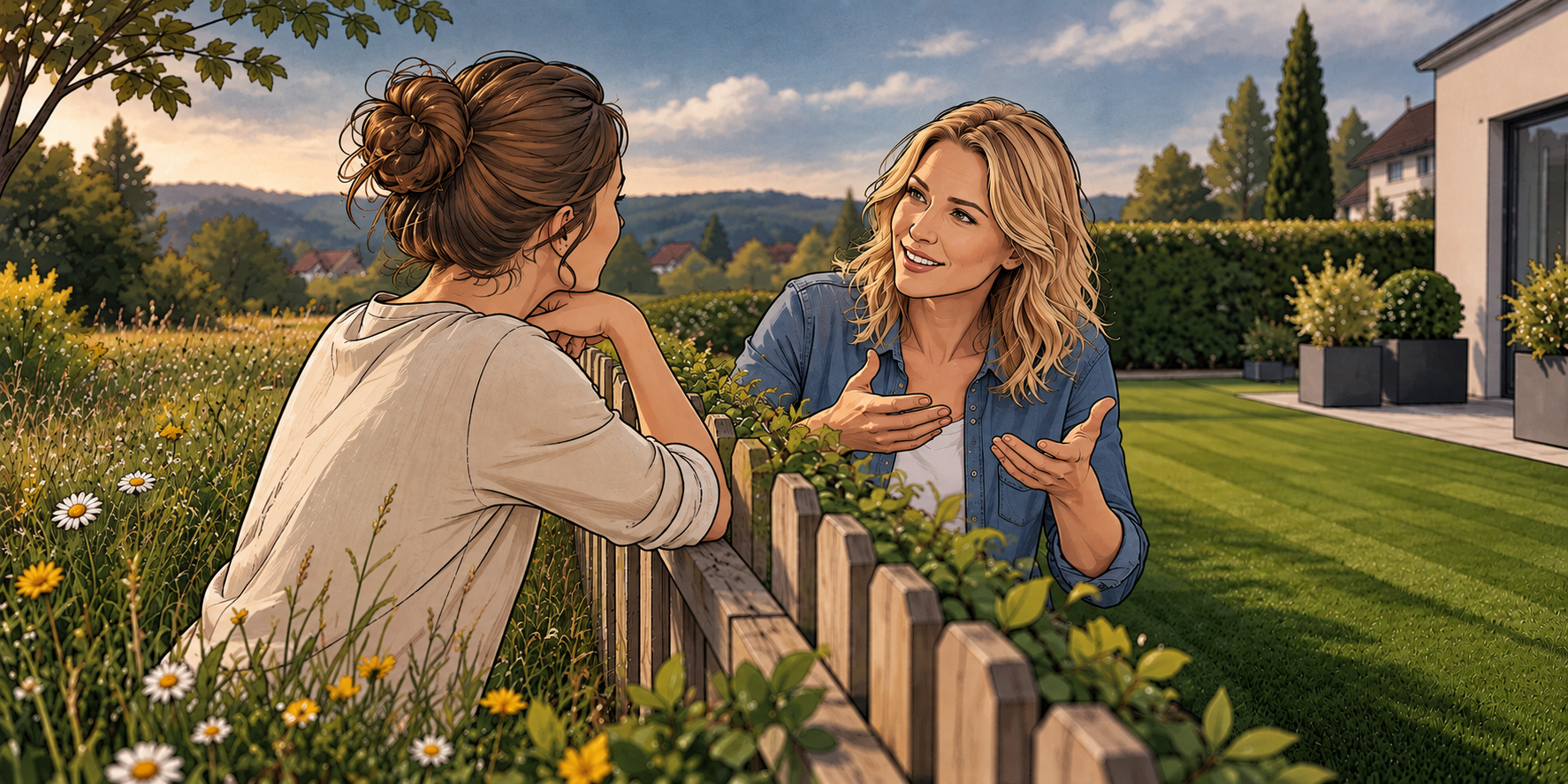
What does he have that I don't? Certainly not what you see on social media. Or do you really believe everyone else's life is more colorful and exciting than yours? What you see there are highlights – and many of them aren't even that, but staged photo shoots: retouched, brightened, color-boosted. Nobody posts the gray days. We all know that. And we compare ourselves anyway. The interesting part: it works the other way around, too. As soon as others think your grass is greener, you suddenly feel obliged to explain it.
How do you respond to “You're always on vacation!”?
That sentence used to really trigger me. Today I know why – and so my answer now is: “True!” Full stop. Many people are quite thrown by that answer. They want to hear an apology – and they expect one. But I don't have to explain or justify myself. Apologize for creating a beautiful life for myself? You can do it too. You just have to actually do it.
And no, I don't just lounge on the beach drinking red wine – although that must never be missing. After 20 minutes on the beach, I'm bored. I want to hike, experience culture and, above all, keep learning. Professional development on vacation? Unthinkable for many. Exactly right for me.
The urge to explain ourselves runs deep. Even when we owe no one anything, we deliver a reason. We make our own grass a little browner so that everyone else's doesn't look so pale.
Why do we constantly justify ourselves?
In short: out of fear of no longer belonging, because of other people's envy, and because we learned it from an early age.
Because we want to belong. For thousands of years, the group was essential for survival. Anyone who stood out too much risked being cast out. That program is still running today. With every explanation, we send the signal: “Don't worry, I'm no better than you.”
Because envy is often behind the remark. “You're always on vacation” is rarely a harmless observation. Usually there's a comparison behind it – one that doesn't turn out well for the other person. And we promptly provide the balance: It was a bargain. I was working the whole time anyway. It was really for business.
Because we learned it from an early age. And not only at home. Anyone who had to go to confession as a child knows what I'm talking about. There we sat in the confessional, listing sins that weren't sins at all: a little fib, teasing our sister, dawdling at dinner. For me, there's no such thing as sin anyway – and certainly not in children. Children don't sin, children experiment. That's how they learn. What nonsense to tell them otherwise.
School picked up where church left off. In front of teachers and other so-called authorities, we constantly had to answer for ourselves: “Why did you do that?” “What were you thinking?” Good grief, we were children! Testing boundaries is what children do. And most of the time we weren't thinking anything at all – except perhaps: Let's see what happens.
Childhood is long gone, but sadly the justifications have stayed. Today there's no priest behind the grille and no teacher at the front of the class. And yet we still answer as if we had to account to them – the moment someone raises an eyebrow or says: “You're always on vacation.”
What happens when you justify yourself?
You prove the other person right. Because every justification is a small admission of guilt. As soon as you start explaining, you silently accept that there's something to explain.
And not only that: with every justification, you prove to yourself that you don't actually allow yourself to have it. Not the vacation, not the pleasure, not the beautiful life. That is usually a much bigger issue than the other person's remark. And that's exactly where it pays to start – on your own or together with me.
How do you stop constantly justifying yourself?
The first step: notice the reflex. You won't get rid of it overnight, but just noticing it changes something. The next time you catch yourself playing down your life, ask yourself: Am I doing this for the other person? Or because I don't allow it for myself?
And then try a simple “True!” No playing it down, no apology, no afterthought. You'll be amazed: suddenly the ball is in the other person's court.
Where don't you allow yourself something – and where does that come from? This is exactly what I focus on in my coaching sessions and readings – together we look at what drives you and what holds you back, so that you no longer have to explain your life but can simply live it. Whether in Dornbirn, Vienna or online: feel free to get in touch: info@sn-coaching.com
Because you don't have to paint your grass brown so that others feel better. And you don't have to look enviously over the fence either – the grass there is often artificial anyway. Take care of your own lawn. It can be as green as you want it to be. And if it's not perfect – or even a little artificial? “True!” Own it!
Frequently asked questions about justifying yourself
Because the reflex runs deep. We want to belong, we react to other people's envy, and from an early age we learned to answer for everything – at home, at school and often at church too.
Often, yes. When you justify yourself, you prove to yourself that you don't fully allow yourself something – the vacation, the pleasure or simply a beautiful life. That's exactly where it's worth taking a closer look.
Try a simple “True!” – no playing it down, no apology, no afterthought. That way you don't accept the hidden accusation, and the ball is in the other person's court.
Remarks like “You're always on vacation” are rarely harmless. Usually there's a comparison behind them that doesn't turn out well for the other person. With our justification, we provide the balance – at our own expense.
In coaching, we look together at where you don't allow yourself something and where that comes from. Silvia Nussbaumer supports you in Dornbirn, Vienna or online.
About Me
Silvia Nussbaumer is an expert in face reading, profiling and leadership coaching with more than 20 years of experience. Internationally trained and with an equally international clientele from business, industry, private individuals and the police, I see myself as an interpreter between people and the body – I read personality, talents and life tasks and make this knowledge usable in coaching sessions and readings. More about me